The region of Hradec Králové has been a significant area of settlement ever since prehistory. Representatives of different cultures came there one after another and the settlement was mostly concentrated along the river Elbe and other water courses.
Since the 10th century the region played an important role in the process of the constitution of the Czech state. One hundred years later Hradec Králové became a seat of castle wardens, an administrative centre of the Church and at one time Hradec Králové region was even a princely estate. That was the tradition that gave rise to the Hradec Králové region later towards the end of the 13th century. Its significance rose as a result of the creation of fortified royal towns (Hradec Králové, Jaroměř, Dvůr Králové nad Labem, Trutnov, Nový Bydžov), to become later, at the beginning of the 14th century, dowry towns of the Czech queens.
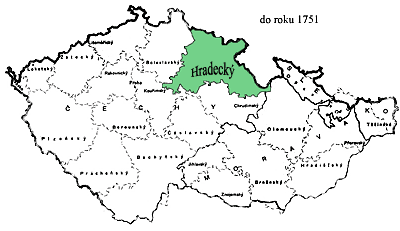
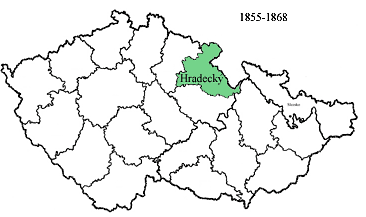
The cultural and economic development of the region was stimulated by the establishment of a number of monasteries, among which the most influential was the one in Broumov. The Polish or Klodzko important trading path cut through the region connecting Prague and Silesia a Poland. In the 15th century the region of Hradec Králové became a notable centre of the Hussite revolution and in the years 1423-1424 the military leader Jan Žižka had his seat there. Once the Hussite wars were over, the region played a major role within the union of east-Bohemian regions and the Hradec Králové region - Circulus Reginohradecensis - remained an administrative whole until the establishment of regional system of government in the year 1862. Two commissioners representing the gentry and lower nobility were at its head. Since the year 1751 only one commissioner administered the region as the representative of the national government. |
|
The economic and cultural development of the region in the 16th century was influenced greatly both by the spread and rise of the bondage towns (Náchod, Rychnov nad Kněžnou, Broumov, Jičín, Vrchlabí, Hostinné and others), and of the large estates of the houses of Poděbrady, Pernštejn, Smiřice or the Trčkas of Lípa. The brief stay of Albrecht of Wallenstein at Jičín during the Thirty Years´ War was not without significance.
|
After the war Hradec Králové became a major centre of Counter Reformation. in 1636 a Jesuit College was founded there and in the year 1664
the bishopric of the Roman Catholic Church. In spite of that, secret reformed protestants remained present throughout the former Hussite region during the whole
of the 18th century even when the process of recatholization was completed. The increasing demands for compulsory labour and general oppression of the serfs led
to a number of peasants´ risings that culminated in the cruelly suppressed major rising in the year 1775 which gave rise to the saying „to comme off as the peasants
at Chlumec“. Certain reforms and the establishment of manufactories led to the economic development of the region. The canvas manufacturing at Potštejn and the Trutnov
trading company were successful both nationally and internationally. |
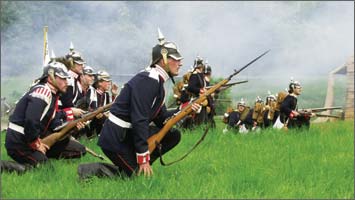
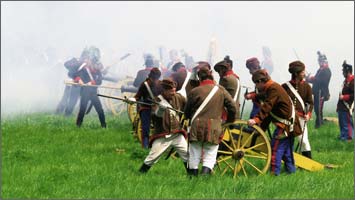
The general economic picture of the region was then complemented by the exploitation of iron and other ores including silver in the Krkonoše mountains and glass manufacturing in the Orlické mountains. In the surroundings of Žacléř and Jestřebí mountains coal mining developed in the 18th century. After the separation of Klodzko and most of Silesia from the Habsburg Empire in the mid-18th century, the Hradec Králové region suddenly became a border land of the country. This fact led to the fundamental reconstruction of Hradec Králové into a modern fort, assisted by the construction of the brand-new Josefov fort. As a result of that the region became the principal battle-field of the Prussian-Austrian war in the year 1866.
|
|
At the turn of the 18th and 19th centuries the Hradec Králové region became the second most important centre of the National Revival after Prague. Various societies and groups of patriotic intellectuals undertook numerous activities for public enlightenment, initiated the work of significant printing houses, development of education and of the theatres in Hradec Králové and in other surrounding localities, which stimulated its overall cultural development in the subsequent years.
The industrial revolution started to transform the agrarian profile of the Hradec Králové region in the mid-19th century. It gave rise to a wide range of sugar refineries, textile and engineering factories. As early as in 1857 one of the first railway lines in the country was built. Most towns started to develop and the population increased. Hradec Králové gradually expanded into an industrial centre and at the beginning of the 20th century its remarkable reconstruction into a modern metropolis started. The architectural project of urban development designed by J. Gočár brought Hradec Králové the reputation of model town planning.
The threat to Czechoslovakia in the years 1935-1938 initiated the construction of borderline fortifications which until this day symbolize the determination of the country to defend itself aginst nazism.
When the German population was expelled from the country after the year 1945 the economy and life in general of the border regions were heavily hit. Equally negative for the whole area was the influence of the destruction of private enterprise after the year 1948. The system of communist planning led to the disappearance of local variety that is so characteristic for the Hradec Králové region.
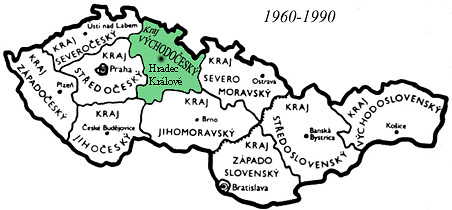
In the year 1949 Hradec Králové once again became the official seat of the region and in the years 1960-1990 it was the administrative center of the whole East-Bohemian region. The creation of the Hradec Králové region after the renewal of regional system of government in the year 2000 continues the thousand-year long development of administration of the Czech state and concludes the contemporary proces of decentralization of the Czech Republic.